
4
For most working parents, Saturday morning does not begin with leisurely coffee or quiet reflection. It begins with an inventory. While the kids search for soccer shin guards or queue up a cartoon, parents survey the physical fallout of the workweek: grease mist settling on the stove hood, an accumulation of dog hair along the hallway baseboards, dried toothpaste across the bathroom mirrors, and a kitchen sink that seems to generate dirty dishes through spontaneous generation.
Before anyone has even stepped outside, a silent negotiation takes place. Who scrubs the downstairs bathroom? Who vacuums the stairs? By the time the sponges and buckets are finally put away, half the weekend has evaporated, replaced by sore backs and a lingering sense of domestic fatigue.
The long-standing cultural assumption that a clean home must always be the product of personal labor has quietly unraveled. For modern households juggling dual careers, extracurricular logistics, school projects, and caregiving duties, outsourcing residential cleaning is no longer an occasional indulgence or a luxury reserved for large estates. It has become a practical management decision—a calculated reallocation of finite human energy designed to keep family life functional, healthy, and humane.
The Hidden Cost of the Weekend Chore Shift
When deep domestic chores are deferred until Saturday and Sunday, families end up clocking what sociologists describe as an unpaid second shift. The standard workweek provides little margin for thorough housework. Between commuting, remote work deadlines, dinner preparation, homework supervision, and bedtime routines, weekday cleaning rarely amounts to more than surface-level triage: clearing the kitchen island, running the dishwasher, and keeping floor pathways clear.
The substantial maintenance tasks inevitably slide into the weekend. Dusting furniture, scrubbing shower tile, mopping hard floors, and disinfecting fixtures require sustained blocks of time. When parents dedicate five or six hours across Saturday and Sunday tackling these chores, they sacrifice the very restorative downtime that prevents occupational and parental burnout.
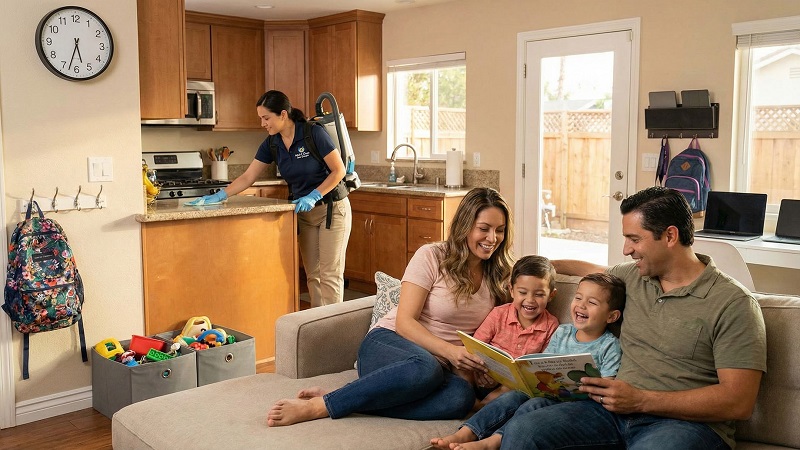
Weekends are intended to provide decompression, creative play, and genuine connection. When that time is colonized by scouring powder and vacuum cords, parents return to Monday morning feeling just as depleted as they were on Friday evening. Hiring a regular cleaning service recovers those lost weekend hours, returning full days of true leisure to the household calendar every single month.
Offloading the Invisible Mental Load
Physical exertion is only half the burden; the psychological weight of home upkeep is often far more exhausting. Even while sitting at an office desk or watching a child’s swim meet, an ambient list of incomplete household chores constantly hums in the back of a parent’s mind.
This cognitive friction—remembering when the sheets were last changed, tracking down cleaning supplies, noticing grout discoloration, feeling quiet guilt over dusty blinds—drains daily mental bandwidth. For couples, it also serves as a persistent catalyst for household tension. Dividing domestic chores equitably is notoriously difficult because the administrative effort of noticing and planning chores often falls unevenly on one partner.
A recurring cleaning service eliminates the need to negotiate, track, or delegate those tasks. The standard is established, the appointment is fixed on the calendar, and the execution is guaranteed. Removing deep cleaning from the family chore roster frees up valuable mental real estate, allowing parents to focus their attention on career milestones, personal well-being, and unhurried interactions with their children.
The Gap Between Surface Tidying and Legitimate Deep Cleaning
Most busy parents excel at tidying, which is fundamentally the process of returning items to their designated spots. Backpacks are hung by the door, shoes are tucked into cubbies, toys are gathered into baskets, and mail is sorted. Tidying makes a home look visually organized from across the room, but it does very little to address embedded grime, allergens, or true sanitation.
Professional residential cleaners approach a home with a completely different set of tools, techniques, and operational standards:
Commercial-Grade Filtration and Dust Removal
Standard household vacuums frequently expel microscopic dust, pet dander, and pollen back into ambient room air through porous housings and standard exhaust filters. Professional teams utilize commercial vacuums equipped with high-efficiency particulate air (HEPA) filtration systems designed to capture 99.97% of airborne particles down to 0.3 microns. For households managing seasonal allergies, pet shedding, or pediatric asthma, this distinction translates directly into noticeably crisper indoor air.
Methodical Technique and Proper Disinfectant Dwell Time
Effective sanitation relies on chemistry and patience. Most homeowners spray a multi-surface cleaner and wipe it off within seconds, never allowing the disinfectant agents sufficient dwell time to neutralize bacteria or break down stubborn grease films. Professional cleaners operate through structured top-to-bottom and dry-to-wet workflows, giving active formulas time to work before lifting residue away with color-coded microfiber towels that prevent cross-contamination between rooms.
Attention to Overlooked Micro-Environments
When families clean in rushed bursts, they naturally skip the areas that require deliberate physical effort. Cabinet faces, door jambs, light switches, baseboard corners, shower door tracks, and ceiling fan blades collect airborne oils and dust for months unnoticed. A structured cleaning schedule ensures these forgotten architectural details receive systematic care before built-up grime causes permanent surface wear.
Protecting Relationship Harmony and Reducing Daily Friction
Ask couples what triggers their sharpest domestic arguments, and the division of household labor will almost always rank near the top of the list. Disagreements rarely center on the physical task of cleaning; they stem from conflicting standards of cleanliness, feelings of unreciprocated effort, and the exhaustion of having to ask for help.
When one partner feels like the default facility manager while the other feels micromanaged, domestic intimacy quickly suffers. Over time, recurring arguments over dirty baseboards or unwashed sinks build subtle walls of resentment.
Bringing in an independent cleaning service fundamentally resets this dynamic. The responsibility for deep cleaning is externalized to an impartial professional. Neither partner needs to keep score, assign chores, or feel resentful about spending a sunny Sunday afternoon scrubbing soap scum. The home simply gets cleaned to an agreed-upon professional standard. That operational shift dissolves a major source of friction, replacing mutual frustration with shared relief when walking through the door.
Creating a Healthier Living Environment for Growing Kids
Children spend a tremendous amount of time on the floor. They crawl on area rugs, play board games on hardwood surfaces, handle toys, and touch communal handrails before putting their hands near their faces. In homes with toddlers and elementary-school students, high-touch zones quickly turn into pathways for seasonal viruses.
Cabinet hardware, refrigerator handles, stair railings, and faucet levers carry heavy microbial loads throughout the school year. A professional cleaning visit provides a thorough sanitizing sweep that helps interrupt illness transmission cycles within the household.
Moreover, regular extraction of embedded dander, dust mites, and outdoor soil from rugs and upholstered furniture significantly lowers the daily allergen burden. When children sleep and play in spaces with cleaner air and lower dust levels, sleep quality improves and morning congestion noticeably drops.
Reframing Domestic Outsourcing as a Strategic Time Investment
Many families hesitate to hire professional cleaners because of an inherited belief that paying someone else to clean is an unnecessary expense. Yet those same households routinely pay for vehicle oil changes, tax preparation software, landscaping maintenance, or grocery delivery without a second thought.
The real metric to evaluate is opportunity cost. If two working parents spend a combined six hours every weekend cleaning, that represents roughly twenty-four hours of manual labor every month. The question becomes what those twenty-four hours are worth when spent elsewhere.
For some parents, those hours represent billable professional work or quiet focus for continuing education. For others, they represent dedicated time to coach a child’s soccer team, cook nutritious meals from scratch, exercise, or simply sit outdoors with a book without guilt. When viewed through the lens of hourly time value and physical well-being, professional cleaning is not a luxury expense—it is a deliberate investment in a family’s baseline quality of life.
The Calming Impact of a Restored Home
Physical environments have a direct, measurable influence on the human nervous system. Cluttered, dusty, and grimy spaces produce low-level sensory noise that makes it difficult for both adults and children to decompress after an intense school or workday.
Stepping into a home that smells naturally clean, with streak-free countertops, thoroughly vacuumed floors, and spotless bathrooms, creates an immediate physical sigh of relief. It turns a chaotic household back into a sanctuary where family members can truly recharge. For modern families navigating demanding schedules, that sense of daily calm is the quiet foundation of a happy, sustainable home life.
